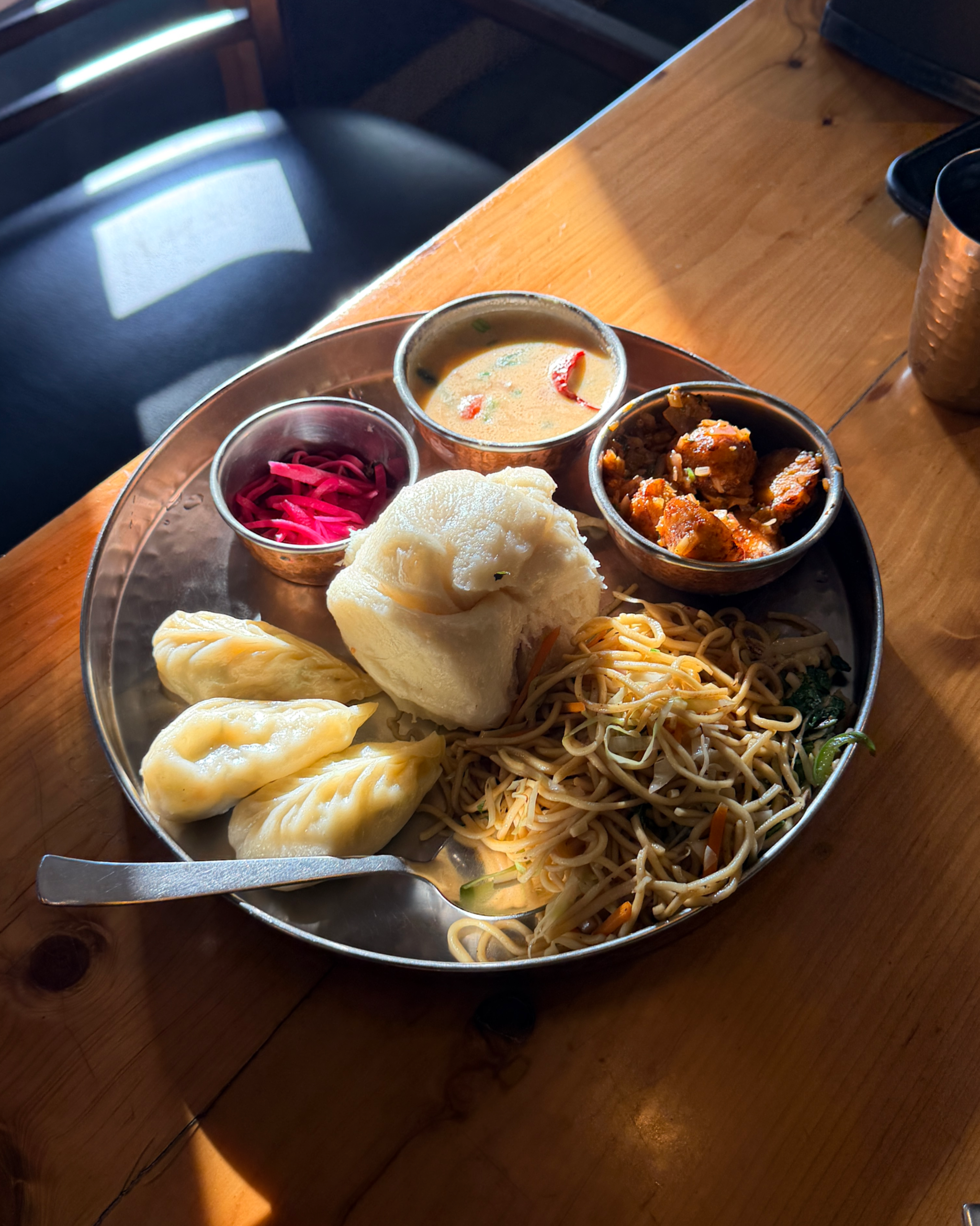

What if travelling across India didn’t require a train ticket or a flight? All you need to do is try regional food in Delhi. From all the states in India.
Every weekday morning, somewhere between Connaught Place and Chanakyapuri, cooks light stoves in the canteens of Andhra Bhawan, Kerala House, Tamil Nadu House and Banga Bhawan.
They stir rice in steel vessels, temper coconut oil with mustard seeds, and lay out thalis whose recipes haven’t changed in three generations. By lunch, civil servants, students, migrants and curious diners sit down to the food of states they may never have visited.
This is the quiet miracle of Delhi’s regional food map. India’s capital has always been a city of arrivals of bureaucrats on transfer, of students pursuing better colleges, of refugees, of workers, of brides and grooms who carry their mother’s kitchen in their suitcases.
Over decades, those arrivals have stitched a culinary atlas of the country onto a single city. The Migration Policy Institute-style population flows that have shaped Delhi since Independence also shaped its lunch boxes. When a community settles in a new city, it tends to open three things first: a temple, a school, and a kitchen.
The kitchens became the most interesting of the three. A Bengali government employee posted to Delhi in the 1970s eventually turned a corner of Banga Bhawan into a canteen serving kosha mangsho and bhetki paturi.
A clutch of Naga students renting rooms in Humayunpur began cooking smoked pork with axone for friends, and one night offered it to a neighbour. Slowly, the neighbour’s landlord became a regular.
Within ten years, the pavement outside their room had become an open-air Naga restaurant serving rice beer and smoked pork to strangers who queued for forty minutes and left with tears in their eyes.
The same story repeats in almost every direction. Kerala House’s Samridhi canteen now feeds lunch to office workers across Janpath for less than the price of a coffee. The Potbelly sits inside Bihar Niwas, in Chanakyapuri, and serves litti chokha in a setting that looks like a village courtyard. Goa Niwas operates Viva O’ Viva, whose fish curries have been reviewed in serious food magazines. Forty-five kilometres of streets, government canteens, and one remarkable South Delhi neighbourhood have become the closest thing India has to a single edible museum of the entire country.
What follows is a journey through that museum. Twenty-eight states, organised into five regional chapters because Indian food refuses to respect exact borders, and stopped at the kitchens, canteens and restaurants that most honestly represent those cuisines today. Some of these are humble — steel trays, plastic chairs, the kind of rooms where the ceiling fans spin at one fixed speed. Some are serious dining rooms. All of them, taken together, prove one idea: food can be its own form of travel.
Table Of Contents
Quick Guide
| State | What Defines the Cuisine | Must-Try Dishes | Where to Begin in Delhi |
|---|---|---|---|
| Andhra Pradesh | Chillies, tamarind, rice, Hyderabadi dum | Chicken/mutton biryani, Pesarattu, Gongura pickle | Andhra Bhawan Canteen, Feroze Shah Road |
| Arunachal Pradesh | Bamboo, fermented pork, tribal herbs | Momos, Thukpa, Pika Pila | Momo Mia stall, Dilli Haat INA |
| Assam | Fish, rice, fermentations, minimal spice on meat | Duck curry (Kumura), Masor Tenga, Khar | Maihang at Assam House; Oh! Assam, Humayunpur |
| Bihar | Sattu, mustard oil, smoked finishes | Litti Chokha, Champaran Mutton, Sattu Paratha | The Potbelly, Bihar Niwas; Bihar Central, Lajpat Nagar |
| Chhattisgarh | Rice, lentils, fara, tribal preparations | Fara, Bafauri, Chana Sattu | Dilli Haat Chhattisgarh stall (seasonal) |
| Goa | Coconut, vinegar, kokum, seafood | Fish Curry-Rice, Xacuti, Cafreal, Bebinca | Viva O’ Viva at Goa Niwas |
| Gujarat | Vegetarian, sweet-sour balance, dhokla culture | Dhokla, Thepla, Undhiyu, Gujarati Thali | Suruchi Restaurant, Karol Bagh; Garvi Gujarat |
| Haryana | Bajra, besan, dairy, sturdy village cooking | Bajra Roti with Churma, Kachri ki Sabzi, Besan Masala Roti | Dilli Haat and select Punjabi-Haryanvi dhabas |
| Himachal Pradesh | Smoked meats, siddu, dham, mountain dairy | Dham, Siddu, Tudkiya Bhath, Aktori | Pahadi Kitchen & Bistro; Yeti in CP (overlaps) |
| Jharkhand | Rice, dhuska, sattu, tribal roots | Dhuska, Ghugni, Rugra, Thekua | Limited dedicated venues; community dinners only |
| Karnataka | Bisi Bele Bath, benne dosa, Udupi vegetarian | Benne Dosa, Bisi Bele Bath, Filter Coffee, Maddur Vada | Karnataka Bhavan canteen; Karnataka Food Centre |
| Kerala | Coconut, tapioca, fish, spice trade heritage | Appam-Stew, Fish Molee, Malabar Parotta, Kerala Fish Curry | Kerala House Samridhi; Bolgatty Palace |
| Madhya Pradesh | Wheat, ghee, Malwa sweets, bhutte-ka-kees | Dal Bafla, Bhutte ka Kees, Poha Jalebi, Indori Sev | Dilli Haat stalls; select North Indian restaurants |
| Maharashtra | Coastal fish, Vidarbha spiciness, Anglo-Indian influences | Pav Bhaji, Misal Pav, Vada Pav, Puran Poli, Kolhapuri Mutton | Maharashtra Sadan canteen; Aaswad; Bombay Sweet Shop |
| Manipur | Fermented fish, bamboo shoots, smoked pork | Eromba, Singju, Kangsoi, Chak-hao Kheer | The Categorical Eat-Pham, Safdarjung; Hentak, Humayunpur |
| Meghalaya | Forest produce, smoked meat, bamboo-cooked fish | Jadoh, Doh Khlieh, Tungrymbai | Pop-ups and Northeast community kitchens |
| Mizoram | Pork-centric, bamboo steam, Vawkbai | Bai, Vawkset, Chhum Han, Mui | Mizo Diner, Humayunpur |
| Nagaland | Smoked pork, axone, rice beer, Naga chilli | Smoked Pork, Bamboo Shoot Fry, Akhuni Pitha, Anishi | Hornbill, Safdarjung; Dzükou Tribal Kitchen; Nagaland stall, Dilli Haat |
| Odisha | Temple-town vegetarian, seafood, pitha | Dalma, Machha Besara, Chhena Poda, Pitha | Odisha Niwas canteen; Rosei Ghara |
| Punjab | Tandoor, dairy, wheat, robust gravies | Butter Chicken, Dal Makhani, Sarson da Saag, Amritsari Kulcha | Moti Mahal, Daryaganj; Kake Da Hotel; Gulati |
| Rajasthan | Waterless cooking, gram flour, ghee, royal heritage | Dal Baati Churma, Laal Maas, Gatte ki Sabzi, Pyaaz Kachori | Suruchi; Chole Bhature at Sita Ram Diwan Chand |
| Sikkim | Momos, thukpa, Tibetan-Nepalese overlap | Momos, Thukpa, Gundruk Soup, Sel Roti, Phagshapa | New Sikkim House, Humayunpur; Sikkim Restaurant, Chanakyapuri |
| Tamil Nadu | Spice gradients, Chettinad heat, temple-town vegetarian | Chettinad Chicken, Idli-Sambar, Dosa, Filter Coffee | Tamil Nadu House Canteen; Saravana Bhavan |
| Telangana | Hyderabadi biryani, haleem, Miyapur pickles | Hyderabadi Biryani, Haleem, Mirchi ka Salan | Andhra Bhawan (shared) |
| Tripura | Fish, bamboo shoot, berma fermentation | Mui Borok, Pork with Bamboo Shoot, Wahan | Tripura Tribal Kitchen at Dilli Haat INA |
| Uttar Pradesh | Mughlai-Awadhi dum, kebabs, kulfi | Galouti Kebab, Tunday-style Kebab, Lucknowi Biryani, Malai Gilawat | Karim’s; Tunday Kababi; Rasayyah, Meharchand Market |
| Uttarakhand | Kumaoni bhatt, Garhwali chains, lentil dumplings | Kaapa, Phaanu, Chainsoo, Bal Mithai | Pahadi Kitchen & Bistro; Thamel (Himalayan overlap) |
| West Bengal | Fish, mustard, sweets, five-spice panch phoron | Kosha Mangsho, Luchi, Bhetki Paturi, Shorshe Ilish, Mishti Doi | Banga Bhawan canteen / Bijoli Grill; Oh! Calcutta |
North India
Himachal Pradesh: Mountain Smoke and Festival Thalis

The food of Himachal Pradesh grew out of terrain that doesn’t permit abundance.
Long winters, short summers, and a high-altitude agriculture built around maize, wheat, barley and pulses encouraged the Himachali cook to preserve aggressively through smoking, drying, fermentation and the cooking of elaborate one-pot meals called dham.
A dham is not a single dish but a feast: a sequence of rice, dal, rajma, kadhi and sepuri badi served on leaf plates by a boti, or community cook, during weddings, religious gatherings and seasonal festivals.
What distinguishes Himachal from neighbouring Punjab is the use of smoked meat, particularly in regions like Kullu and Chamba, where charu which is dried and smoked meat kept for months, flavours everything from soups to lentils.
Siddu, a stuffed wheat bread steamed over twigs, is paired with desi ghee and a thin dal. Tudkiya bhath, a smoky rice cooked with lentils and spices, has the patience of mountain cooking.
In Delhi, the most reliable way to taste Himachal is at Pahadi Kitchen & Bistro in Humayunpur (62-R/1, 1st Floor, Safdarjung), where the menu folds Himachali, Kumaoni and Garhwali recipes together with a Himalayan sensibility.
Yeti – The Himalayan Kitchen in Connaught Place serves a broader Himalayan menu that overlaps heavily with Himachal, including makai chi bhakri and Himalayan platters.
Punjab: The Tandoor and the Dhaba

Punjab’s plains of wheat and dairy built the country’s most recognisable North Indian plate.
The foundation is rich: makhan (white butter), ghee, cream, paneer, and a tandoor tradition that cooks meats and breads with fierce direct heat. Sarson da saag with makki di roti is the winter signature.
Makhan chicken, dal makhani slow-cooked overnight, butter chicken, Amritsari kulcha and chole bhature together form the menu that the rest of India has collectively decided to call “Indian food.”
In Delhi this cuisine is everywhere, but the most interesting experiences are dual: the historical restaurants that the late Kundan Lal Gujral of Moti Mahal turned into global institutions when he claims to have invented butter chicken and dal makhani in the 1940s-50s.
Moti Mahal on Netaji Subhash Marg in Daryaganj continues as one of the most cited butter chicken addresses in the country, located near where the original kitchen first opened.
Kake Da Hotel in Connaught Place and at Karol Bagh remains the legendary North Indian restaurant whose butter chicken and dal makhani have been queued for since 1937.
Dhaba by Claridges and Gulati at Pandara Road represent the more contemporary, hygienic Punjabi fine-dining tradition. For chole bhature, Sita Ram Diwan Chand in Paharganj/Chawri Bazar has run a same-style breakfast thali since 1950.
Also Read: 30 Incredible Countries That Give Visa on Arrival to Indians (2026 Updated List)
Haryana: The Village Plate Across the Highway

Haryana’s food culture runs shoulder-to-shoulder with Punjab’s — both states share the wheat-dairy-tandoor platform — but it leans further toward rural, sturdy village cooking. Bajra rotis paired with churma, kachri ki sabzi (made from dried wild cucumbers), besan masala roti, kadhi pakora with steaming rice, and the famous hara dhaniya chicken of Jhajjar contribute a humility to the North Indian table that is harder to find in Delhi by name.
There is no single dedicated Haryanvi restaurant of note in Delhi. The most authentic pathway is through Dilli Haat INA, where Haryana-themed food stalls rotate regionally and where one can occasionally find bajra rotis and kachri sabzi on special weekends.
Several Punjabi-style dhabas and roadside eateries around the New Delhi railway station and Hanuman Mandir area serve a style that overlaps heavily with Haryana kitchen, though they usually do not label themselves as such.
Rajasthan: Spice Without Water

Rajasthan is largely arid. Dal, baati, churma, ker sangri, gatte ki sabzi, laal maas, pyaaz kachori and the white-butter-laden sweets of Jodhpur and Bikaner reflect a cuisine designed to keep moisture in and waste out.
Gram flour substitutes where vegetables are scarce. Waterless cooking techniques dry-roast spices. Lentils, dried beans and curd form the backbone since vegetables fight the climate.
In Delhi, Suruchi Restaurant in Karol Bagh serves Rajasthani and Gujarati thalis at an institution scale, having been awarded Best Gujarati Thali recognition and running for over three decades.
Chole Bhature at Sita Ram Diwan Chand (Chawri Bazar) opens with a gravy topped with vinegar pickle and gets its cult following from a single plate.
Rajwada Bhog, with multiple branches, delivers Marwari thalis on banana leaves at lunch.
For an interior-Rajasthan feel, Natraj Dahi Bhalle Wala in Chandni Chowk serves a Rajput-style pyaaz kachori and aloo kachori that has its own long queue.
Uttar Pradesh: The Slow Dum of Lucknow and the Kebab of Old Delhi

Uttar Pradesh’s culinary identity is a federation of regional sub-cuisines: Lucknowi Awadhi with its dum technique, Banarasi street food, Allahabad’s buffet traditions, the Mughal kitchens of Agra. Galouti kebab, tunde ke kebab, biryani of Lucknow, kulfi of Rauza, and breads like sheermal and warqi paratha together define the slow, fragrant Mughlai frontier.
In Delhi, Karim’s near Jama Masjid (since 1913) remains the most historic Old Delhi Mughlai restaurant, famous for its mutton stew and seekh kebab.
Tunday Kababi at Jama Masjid, Aminabad brings the Lucknowi-Awadhi galouti tradition and is one of the most-cited kebab shops in the country.For a contemporary Awadhi dining experience, Rasayyah in Meharchand Market serves Lucknowi and Banarasi plates in a refined setting. Royal Café in Jama Masjid offers a quick-plate Awadhi breakfast and a shahi tukda among breakfast classics.
Also Read: Free Collabs For Travel Content Creators On Headout (I’ve tried it!)
Uttarakhand: Bhatt, Chains, and the Sprout from the Hills
Garhwal and Kumaon are two distinct hill regions that together form Uttarakhand, and both have pushed their food into Delhi through one significant cluster of Himalayan restaurants centred in South Delhi’s Humayunpur.
Phaanu (a slow-cooked lentil preparation), kaapa (greens with malt), chainsoo (black chickpea dal), aloo ke gutke (a fried-potato Kumaoni snack), and bal mithai for dessert are signatures.
Pahadi Kitchen & Bistro in Humayunpur is the most dependable Uttarakhand-Kumaoni address in Delhi, presenting a homestyle Kumaoni, Garhwali and Himachali spread.
Yeti in CP covers the broader Himalayan realm and includes some Uttarakhand-prep dishes.The Garhwal Kitchen and dedicated Kumaoni pop-ups surface occasionally through catering listings.
Also Read: List of VISA-free Countries For Indians: 5th is the Cheapest One!
West & Central India
Gujarat: The Vegetarian Plate With a Sweet Note

Gujarat’s cuisine is predominantly vegetarian in its public form, defined by a snack culture (dhokla, thepla, fafda, khaman), a strong dals-and-rice foundation (khichdi, dal-rice-roti, undhiyu), and a sweet-sour balance that pops up in everything from kadhi to mango pickle.
Vegetarianism, Jain sensitivities and the strong merchant-community vegetarian traditions convert into dishes like handvo, sukhdi and a Gujarati thali that almost invariably includes a sweet item which is typically a dal-based sweet like moong dal no sheero or a slice of shrikhand.
In Delhi, Suruchi Restaurant in Karol Bagh (Paharganj outlet too) is the most long-standing Gujarati thali specialist, with a roti-rotla-thali selection that rotates daily [Tripadvisor 2025; Suruchirestaurants.com]. Garvi Gujarat Bhavan’s restaurant in the Chanakyapuri area serves a leaf-plate Gujarati meal tied closely to the state’s identity. For snack-style Hamam Street Adana plat, Rajwada Bhog continues the Marwari-Gujarati thali tradition.
Maharashtra: Five Sub-Cuisines in One State

Maharashtra carries at least five distinct culinary traditions: Konkani-Malvani on the coast with coconut and seafood; Kolhapuri in the south with bold red-chilli meat dishes; Varhadi-Vidarbha in the east with a fierce, smoky spice profile; Marathi Pune urban with its misal pav culture; and the Anglo-Indian-Mumbai cuisine that gave the world pav bhaji, vada pav and bombil fry.
/im
A single lunch in Maharashtra could easily include sol kadhi, bhakri, mutton Kolhapuri, or fish curry with rice.
In Delhi, Maharashtra Sadan at Mandi House operates a public canteen that serves Maharashtrian breakfast (poha, sabudana vada, misal pav), lunch thalis and snack-window items at government-canteen prices [saltpepperfoodguide.wordpress.com; Instagram review reels 2025]. Aaswad and Aaswad – Aundh branches serve authentic Maharashtra plates including puran poli and matki usal. Bombay Sweet Shop in Fatehpuri and Connaught Place is the contemporary, preservative-free remaking of Mumbai’s snack-bakery heritage and ships its snacks and mithai Pan-India [Bombay Sweet Shop official; JustDial]. Call Chotu – All Day Diner & Bar delivers Mumbai street food in a branded format [Zomato listings 2026].
Goa: Kokum, Vinegar and the Sea on a Plate

Goa’s cuisine is inseparable from its 450-year Portuguese-Marathi interaction. Xacuti, vindaloo, cafreal, fish curry-rice, sorpotel and the coconut-rich bebinca are the products of that particular history.
Kokum, coconut vinegar and toddy are signature ingredients. Goan food in Delhi is one of the harder regional cuisines to find, despite occasional appearances.
Viva O’ Viva, the canteen inside Goa Niwas in Chanakyapuri (Bir Tikendrajit Marg), is the most reliable public Goan-restaurant address in Delhi, serving calamari river fry, xacuti, chicken cafreal and the day’s fish curry-rice.
The canteen historically operates for limited weekday hours, and diners should call before visiting.
A few Goan dishes show up in Costa-coastal restaurants and Goan-specialty home cooks, but the Goa Niwas canteen remains the index experience.
Also Read: Fast Track Immigration in India: Step-by-Step Guide, Skip Long Queues at Airports
Madhya Pradesh: Malwa’s Ghee and the Indori Breakfast

Madhya Pradesh is one vast plateau where Malwa and the eastern tribal belt produce very different food. Malwa feeds Delhi with two main dishes: dal bafla (a heavier, steaming wheat ball version of Rajasthan-style dal baati), bhutte ka kees (grated corn cooked with spices), poha-jalebi (the Indori breakfast of flattened rice with saffron-tinted warm jalebis), and Indori sev served with samosa-kachori. The eastern tribal cuisines use mahua, kodo-kutki millets and forest produce.
In Delhi, finding a dedicated Malwa restaurant is difficult. Dilli Haat INA regularly features Madhya Pradesh stalls serving poha-jalebi and bhutte ka kees.
A handful of small MP-style breakfast joints and select take-aways in Old Delhi serve poha and Indori-style sev at breakfast hours. The dedicated Malwa thali restaurant concept is rarer than Rajasthani or Gujarati equivalents in the capital.
Chhattisgarh: Rice, Fara and the Forest
Chhattisgarh’s food grows out of rice cultivation, dal-based everyday meals, and a strong tribal-Adivasi tradition. Fara (steamed rice dumplings), bafauri (steamed chana dal dumplings), chana sattu (gram flour drink), rakhia badi and chochhi (a sour curry based on taroiya fruit) are the state’s signatures. Meat is part of everyday non-vegetarian food in Bastar, Surguja and other tribal belts.
Delhi coverage of Chhattisgarh is genuinely thin. Dilli Haat INA has periodically featured Chhattisgarh and Bastar food stalls serving fara and other rice-based dishes.
State Bhawan food exposure is limited and there is no mainstream dedicated Chhattisgarhi restaurant of note. Food enthusiasts have to rely on rotating state stalls at Dilli Haat and occasional pop-ups to taste a representative Chhattisgarh plate.
South India
Andhra Pradesh: The Biryani, the Chilli, the Gongura

Andhra cuisine is built around rice, lentil-based stews, a remarkable range of pickles (avakaya, gongura), and a chilliculture that the world envies. Hyderabadi dum biryani, pesarattu (moong bean dosa), pulihora (tamarind rice), guti vankaya (stuffed brinjal), and the state’s signature Gongura-mutton all live under the same Andhra roof.
In Delhi, the Andhra Bhawan Canteen at 1 Ashoka Road is one of the most-cited regional canteens in the country. Chicken biryani runs around ₹300 and the mutton biryani (weekends only) around ₹350.
The canteen is brisk, college-mess-style and open to the public without any ID requirement. For non-veg Andhra-style fried rice, Andhra tiffin centres exist in scattered South Delhi and Karol Bagh locations.
The canteen also shares space with Telangana’s food pulse and many diners treat it as the South Indian-South Central Indian regional canteen.
Telangana: Haleem, Biryani, Mirchi ka Salan

Telangana’s culinary identity overlaps with Hyderabad: dum biryani, haleem (during Ramzan), mirchi ka salan, double-ka-meetha, and a Hyderabadi food culture that the global culinary map knows well. The state’s distinct table is meat-centric, Mughal-influenced and spice-build heavy, with deep ties to the Nizam era.
The Andhra Bhawan Canteen doubles as the Telangana-Biryani entry point for casual visitors. The canteen also serves Telangana-style haleem in Ramzan.
For more contemporary Hyderabadi food, Bikanervala-style restaurants in NCR and select Hyderabadi biryani kitchens in Karkardooma and Saket stock Telangana’s Hyderabadi dum.
Karnataka: Filter Coffee, Benne Dosa, Bisi Bele Bath
Karnataka’s cuisine is geographically plural: Coorg’s pandi curry, Mangalore’s kundapur fish curry, Udupi vegetarian, North Karnataka’s jolada rotti-enneganji, Bangalore’s Iyengar tiffin tradition, and the legendary Mavalli Tiffin Rooms (MTR) and CTR (Central Tiffin Room) of Bangalore that gave Karnataka its iconic idlis, vadas and benne dosa profile [Wikipedia – MTR; Tripadvisor MTR].
In Delhi, the Karnataka Bhavan canteen at Chanakyapuri has been relocated from its earlier address and currently serves Karnataka, Tamil Nadu, Andhra Pradesh and Kerala-style dishes at canteen prices.
Karnataka Food Centre near Janpath / Connaught Place area is a long-running Karnataka-style South Indian canteen serving masala dosa, kesari bath and curd rice.
Hotel Saravana Bhavan in Connaught Place and at Karol Bagh does vegetarian Tamil Nadu-Karnataka overlap plates for urban diners
Kerala: Coconut, Black Pepper, and the Sea in the Curry

Kerala cuisine is shaped by the spice trade, the backwaters and the Arabian Sea. Coconut, black pepper, cardamom, curry leaves, tapioca, and an astonishingly diverse freshwater-and-seafood portfolio define the state.
Appam with stew, fish molee, Kerala fish curry with kanji (rice gruel), Malabar parotta with beef fry, and the sacred sadya served on banana leaves are quintessentially Kerala.
Kerala House Canteen (Samridhi) at 3 Jantar Mantar Road, New Delhi is the most affordable Kerala-food experience in the country. The vegetarian thali runs ₹80 with unlimited rice, while fish fry, pepper chicken and meat-roast carry the non-veg side. Bolgatty Palace Kerala Restaurant and Annie’s Kerala Kitchen in East Patel Nagar are older civil-servant hangouts serving Kerala-style fish and breakfasts. Asian Haus in Delhi serves Kerala-influenced plates in a more cafe-style environment.
Tamil Nadu: Chettinad, Idlis and Filter Coffee

Tamil Nadu cuisine is the most codified of the South Indian food cultures. Chettinad cuisine uses a defined masala palette — stone-ground red grilled chillies, coriander, fennel, star anise, pepper — making Chettinad chicken and Chettinad mushroom some of the most recognisable South Indian plates. Idli-sambar-chutney for breakfast, dosa-varieties for any meal, sambar rice, rasam, kootu and curd rice define the everyday meal. Filter coffee in a steel davara-tumbler is non-negotiable.
Tamil Nadu House Canteen at Chanakyapuri (near Kautilya Marg) is the state canteen serving Chettinad chicken, ghee roast dosa, idli and filter coffee [District app; Zomato Tamil Nadu House; magicpin menu]. Hotel Saravana Bhavan’s Delhi branches have served Tamil-style vegetarian plates since 1990
East India
West Bengal: Five Spices, Bhetki, and the Rosogulla

The Bengali pantry is built around five-spice panch phoron, mustard seeds, poppy seeds, coconut and the state’s legendary fish — rohu, katla, hilsa, bhetki, pabda. Kosha mangsho (slow-cooked mutton), shorshe ilish (hilsa in mustard), chingri malai curry, bhetki paturi, luchi-alur dom, and a sweet tradition (rasogulla, sandesh, mishti doi, pantua) form the other half of the table.
Banga Bhawan canteen, aptly named Bijoli Grill on the first floor of Banga Bhawan at 3 Hailey Road, near Mandi House, runs as the state’s food embassy in Delhi, with mutton kosha, fish curry, bhetki paturi and a Bengali non-veg thali on the menu.
The canteen operates within Banga Bhawan’s timings, generally open to the public for lunch and with a moderately priced thali.Oh! Calcutta at multiple outlets represents the contemporary Bengali-fine-dining tradition in Delhi.
Odisha: The Temple-Town Vegetarian, and a Hidden Seafood Tradition

Odisha’s food culture runs parallel to its temple traditions. The temple-town vegetarian plate consists of dalma (lentil-vegetable stew), saga bhaja (leafy greens fry), besara (mustard-based curry).
The state’s coastal tradition with machha besara (fish in mustard curry), chhena poda (baked cottage cheese dessert), and pitha (rice flour dumplings) appear in wedding and festival kitchens.
Odisha Niwas canteen at 4 Bordoloi Marg in Chanakyapuri (also listed as 1 Niti Marg in earlier records) is the state’s canteen, serving chuna maach, dalma and Odia thalis along with pitha and chenna sweets.
Rosei Ghara is a home-style Odia kitchen delivering through Zomato/Swiggy with thali-based menus.Odraa runs as a Bhubaneswar-origin brand hosting Delhi pop-ups and catering events for the diaspora.
Bihar: The Smoky Litti and the Slow-Burn Mutton

Bihar’s food is fast becoming one of India’s most exciting regional cuisines. The state’s signature is litti chokha which is wheat flour balls stuffed with roasted sattu, baked on coals, served with smoked brinjal and tomato chokha.
Champaran mutton (a smoked, mustard-cured preparation) today defines the dining-out version of Bihari non-veg.
The Potbelly Bihari Kitchen sits inside Bihar Niwas at Plot No. 15, Tikendrajit Marg, Chanakyapuri, and is the most famous Bihari restaurant in Delhi.
It’s around the ₹2,200-for-two range and serves Maithili Thali, Dalpitti and Tomato Chokha alongside Litti [District app]. Bihar Central at Lajpat Nagar serves champaran mutton and litti chokha in a casual café setting.
Many Bihari-run canteens in Rajinder Nagar and Karol Bagh form an informal fourth-fifth decade of regional presence.
Jharkhand: The Rice Plate and the Tribal Forest Kitchen

Jharkhand carries a layered culinary identity: a Santhal, Munda, Oraon Adivasi forest-food tradition layered on a Bihari-adjacent north-Indian kitchen.
Dhuska (a rice-and-lentil fried snack), ghugni (a black chickpea curry), rugra (a wild mushroom from the sal forests), and thekua are signatures. The food sits in a catalogue with limited urban Indian restaurant representation.
Delhi options for Jharkhand are genuinely the rarest in mainstream regional Indian cuisine. The most authentic way to sample Jharkhand is through rotating food stalls at Dilli Haat INA during cultural festivals.
There is no currently operating dedicated Jharkhandi restaurant of significance in Delhi; readers seeking Jharkhandi plates are best served by attending Chhath Puja community meals in NCR.
Northeast India
Arunachal Pradesh: Rice, Bamboo, and Momo Eat India

Arunachal’s cuisine varies substantially by tribe: Adi, Apatani, Galo, Nyishi, Wancho and centres on rice, fermented soybean, smoked pork and bamboo-steamed fish.
Pika pila (a fermented bamboo shoot pickle), bamboo-cooked fish, smoked meat and tribal-millet chutneys are central. Momos have crossed over to become the most visible Arunachali food at national stalls.
The Momo Mia stall at Dilli Haat INA (Stall No. 6, Arunachal Tourism Food Stall) serves steamed and fried momos alongside thukpa and a few Arunachali dishes.
Arunachal Bhawan in Chanakyapuri receives visitors for official business but does not host a reliable public canteen comparable to its neighbouring state canteens. The Arunachal Pradesh restaurant in Humayunpur (a small tribal community kitchen) has been referenced in regional food walks.
Assam: Fish, Ferment, and the Quiet Power of Tea

Assamese cuisine is fish-and-rice grounded: masor tenga (sour fish curry), khar (a unique alkaline preparation), aloo pitika (mashed potato with mustard), duck curry (“kumura”), tenga-rice-fermented combinations.
Pitha, narikol ladu (coconut laddoos) and the Assam tea belt’s relationship with food define the rest.
Assam House, located on Kautilya Marg in Chanakyapuri, has an evolving in-house canteen that has been described in 2025 reviews as Maihang, an Assamese lunch service with everyday Bengali-bordering Assamese plates.
Oh! Assam in Humayunpur is a dedicated Assamese restaurant serving tangy, less-spiced delicacies; Eat (H)e’s “bamboo shoot and silkworm” preparations are sometimes available, but the simpler masor tenga and duck curry are crowd-pleasers.
Manipur: Eromba, Singju, and the Meitei Plate

Manipur’s food is among the most distinctive in India. The Meitei kitchen uses fermented fish (ngari), bamboo shoot, ghost-chilli (umorok) and small amounts of oil to produce intensely flavoured dishes.
Eromba (a mashed vegetable with fermented fish), singju (vegetable salad with roasted nuts), kangsoi (a clear soup), chamthong (a stew), and smoked pork with potato are key.
The Categorical Eat-Pham at Safdarjung Enclave is the contemporary Manipuri home-kitchen flag-bearer, with smoked-pork thali, eromba and kangsoi on the dinner menu.
Hentak at Humayunpur-Safdarjung opened as a conceptual Manipuri restaurant reimagining Manipuri cuisine with subtle global technique.
Manipuri Chak-Shang is a newer sit-down Manipuri restaurant accessed through Delhi’s Northeast community networks.
Meghalaya: The Bhoi, Khasis and the Jadoh Plate

Khasi, Jaintia and Garo kitchens together make Meghalaya’s plate. Jadoh (rice cooked with meat, often smoked pork), doh khlieh (a spicy pork-meat salad), tungrymbai (fermented soybean chutney), putharo (rice pancake) and bamboo-cooked river fish are the cultural markers. Smoked pork with pickled bamboo shoot is an everyday dish.
There is no currently operating dedicated Meghalaya restaurant of note in Delhi. The most direct pathway is through Northeast community events, hummus-pop-food brand Mei-Ramew Café (founded in Meghalaya and franchised to one or two NCR locations via Tie Up) with capsule-tasting menus, and rotating Dilli Haat INA cultural-fest food stalls.
Mizoram: Pork, Bamboo Steam and Vawkbai

Mizoram’s plate is pork-heavy. Bai (vegetable-stew with pork), vawkset (boiled pork with mustard greens), chhum han (steamed fish wrapped in banana leaf), koat pitha (rice cake) and an occasional smoke-dried pork dish with bamboo shoot constitute the kitchen.
Mizo Diner in Humayunpur is the most-cited Mizo restaurant in Delhi. Its menu includes pork with chilli, chicken liver and gizzard dry fry, smoked pork fried rice and chow satui leh.
Their pork-momo buffet is also a Thursday/Friday staple.
Nagaland: Smoked Pork, Axone, and Rice Beer

Naga cuisine has spread further into Delhi than any other Northeast India cuisine. Smoked pork, axone (fermented soybean), bamboo shoot fry, akhuni pitha, naga chilli-based chutneys and pork preparations served with rice beer form the core.
Hornbill Restaurant at 104/A Ground Floor, near NCC Gate, Safdarjung (Humayunpur) is the most established Naga restaurant in Delhi, operating since 2015, and serves smoked pork with yam, axone chutney, fruit beer.
Dzükou Tribal Kitchen is a newer Naga concept that has become known for Naga thalis and tribal-flavour tasting menus.
The Nagaland Food Stall at Dilli Haat INA delivers a more accessible Naga-influenced momo and smoked-pork thali.
Sikkim: Momos, Thukpa and the Tibetan-Himalayan Line

Sikkim shares much of its plate with the broader Tibetan-Nepalese culinary zone. But Sikkim’s specific influence adds gundruk (fermented leafy green), sel roti, phagshapa (a stir-fried pork radish), chow mein chowlaa, and momo with native buckwheat flour.
New Sikkim House, which moved from Chanakyapuri to 168, 1st Floor, Humayunpur in 2024–25, is the most closely Sikkimesse-flavoured choice, with thukpa, tingmo momos, thenthuk and a few Sikkim-specific plates.
Yeti in CP and Momo Mia at Dilli Haat serve broader Himalayan-influenced plates overlapping with Sikkim’s repertoire.
Tripura: Mui Borok and the Forest Plate
Tripura’s Mui Borok tradition is bamboo-shoot-cuisine heavy with fresh river fish. The mui (a fermented bamboo shoot pickle), wahan (stir-fried pork), chakhwi (steamed vegetable), and a range of simple dal-rice-fish curries define the state.
The most accessible Tripuri plate in Delhi is at Tripura Tribal Kitchen inside Dilli Haat INA, which serves Mui Borok thalis including rice, fish curry and a chakhwi-style vegetable curation.
Conclusion
To eat your way across India in Delhi is to understand that India’s regional cuisines are not museum pieces.
They are living things, carried on the train, packed into steel dabbas, opened up on hospital beds and university floors, and transplanted from one kitchen to another with each government transfer, each college admission, each interstate marriage.
Old Delhi’s assumptions about what Indian food looks like and tastes like butter chicken and dal makhani, perfectly valid but inadequate. Give way when you walk through India Gate’s neighbourhood into Andhra Bhawan’s canteen, ride to Chanakyapuri and meter through Goa Niwas, drop into Bihar Niwas for a plate of litti chokha followed by Banga Bhawan’s kosha mangsho, then drive down to Humayunpur for a smoked-pork thali.
What is striking in the journey is how often the State Bhawan — usually a building built for politicians — has been quietly repurposed by its community as a lunchroom and a cultural embassy.
The canteens inside Andhra Bhawan, Kerala House, Bihar Niwas and Goa Niwas are those rare venues where recipes sift up to Delhi from kitchens that have been cooking the same lunch since grandmothers first stepped off trains. Around them, community-led restaurants have grown: Potbelly into a Bihari destination, Hornbill into a Naga flagship, Hentak into a Manipuri editorial, Pau-Pahadi into Pahadi small-batch, Manipur Chamthong into a multicourse tasting room.
Sometimes the easiest way to travel across India is to ask for the rice.

Subscribe to never miss a post!
Leave a Reply