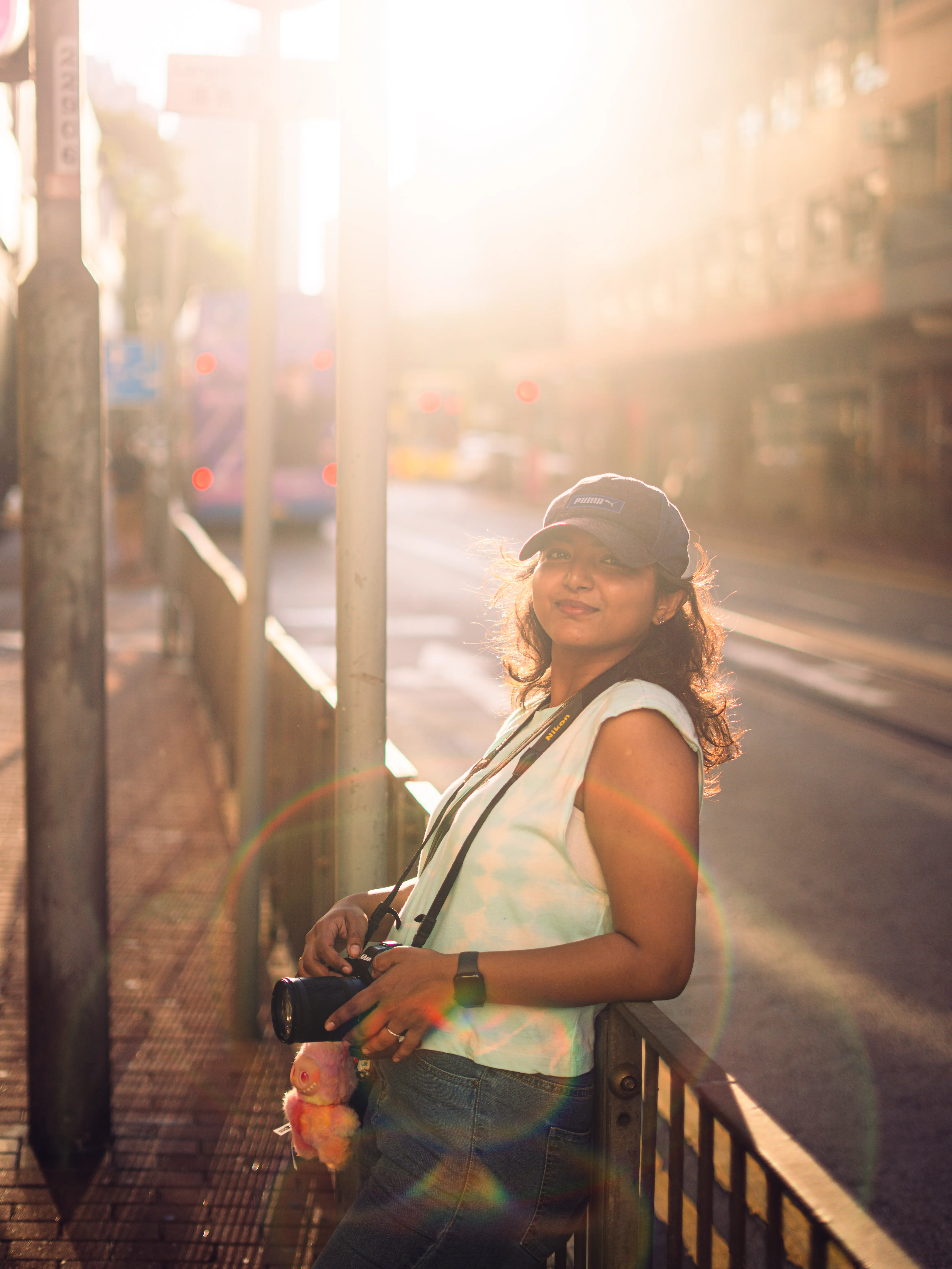
I have spent 14 days in Hong Kong and these are my absolute favorite Hong Kong Photography spots (the ones I could visit because Hong Kong has so many beautiful places).
Hong Kong is a heaven for Photographers.
Everywhere you look, there is a moment to capture.
Hong Kong is one of those cities where I found myself reaching for my camera constantly.
Not because every corner is conventionally beautiful, but because the city has this incredible contrast of scale, colour, architecture, movement and everyday life.
There are towering skyscrapers next to tiny shops, neon signs against concrete buildings, mountains appearing between apartment blocks and incredibly dense streets where something is always happening.
I came to Hong Kong wanting to photograph the city, but I left with a much longer list of places I want to photograph again.
*All of the pictures shown below were shot on my Nikon Z8 camera & edited on Adobe Lightroom
Table Of Contents
Hong Kong Photography Spots You Just Can’t Miss
For iconic Hong Kong architecture
- Choi Hung Estate
- Montane Mansion
- Central
- Bank of China Tower area
For street photography
- Sham Shui Po
- Mong Kok
- Temple Street
- Central and Sheung Wan
For cinematic city views
- Victoria Peak
- Victoria Harbour
- Tsim Sha Tsui
- Sky100 area
For quieter, atmospheric photographs
- Tai O
- Sai Kung
- Nan Lian Garden
- Sheung Wan
1. Kennedy Town Basketball Court
Kennedy Town Basketball Court was one of those Hong Kong photography spots that immediately caught my eye because of how much is happening visually within such a small space.
You have the bright colours of the court, the surrounding residential buildings, palm trees, people playing basketball and, depending on where you stand, glimpses of the harbour.
What I really liked here was the contrast between the colourful court and the dense Hong Kong architecture around it. It gives you that very recognisable Hong Kong feeling without relying on one of the city’s famous landmarks.
If there are people playing, wait for the right moment rather than photographing an empty court. A person moving through the frame gives the photograph scale and makes the scene feel alive.
This is also a great place to experiment with a wider lens. Get low and let the lines of the court lead towards the buildings behind it.
The best photographs here, for me, are not necessarily the ones that show the entire location. They are the ones that capture the relationship between colour, people and architecture.
Also Read: The Only Simplified Japan Travel Guide You Need
2. Man Mo Temple

Man Mo Temple was a completely different photography experience from the colourful and architectural locations around Hong Kong.
Located in Sheung Wan, the temple has this incredible atmosphere created by incense coils hanging from the ceiling, wooden details, red lanterns and shafts of light filtering through the interior.
This is one of those Hong Kong photography locations where slowing down actually makes you a better photographer.
It is tempting to walk in, take a wide photograph of the temple and leave. But there is so much more to photograph if you start looking closely.
I would look for layers created by the hanging incense coils. They can work beautifully as a foreground element with the temple interior behind them.
The smoke is another element worth paying attention to. Depending on the light, it can create beautiful texture and depth in the photograph.
I also found myself photographing smaller details rather than constantly trying to capture the entire space.
Lanterns, carvings, textures, shadows and architectural details can tell the story of a place just as effectively as a wide photograph.
Be mindful of the environment here. This is an active place of worship, so photography should never come at the expense of being respectful.
From a photography perspective, Man Mo Temple is a great reminder that a location does not have to be visually loud to make a strong photograph.

3. Victoria Harbour Skyline

If you are looking for classic Hong Kong photo spots, Victoria Harbour is obviously one of the first places that comes to mind.
But the challenge with photographing an iconic view is making your photograph feel like yours.
The skyline has been photographed millions of times. So rather than simply trying to recreate the postcard shot, I like looking for ways to introduce a different composition.
The harbour gives you an incredible opportunity to use reflections, layers and scale. You have the water in the foreground, boats moving through the middle of the frame and the skyscrapers creating a dramatic backdrop.
I would particularly recommend staying through blue hour.
There is something magical about the period just after sunset when the sky still has colour but the city lights have started coming alive. The combination creates much more depth than photographing the skyline in the middle of the day.
And do not ignore the boats.
A ferry or small boat moving through the harbour can completely change the balance of your frame and provide a sense of scale against the enormous skyline.
For me, this is one of the Hong Kong photography spots where patience is more important than equipment.
Find your composition, set up and wait.
The city will eventually give you the photograph.
Products by Category


4. Victoria’s Peak

Victoria Peak is probably one of the most obvious places to photograph Hong Kong, but obvious does not mean overrated.
When you stand above the city and see Hong Kong spread out beneath you, it is genuinely difficult not to reach for your camera.
What makes this one of the best photography spots in Hong Kong is the sheer scale of the view.
You can see the skyscrapers packed tightly together, Victoria Harbour cutting through the city and the mountains disappearing into the distance.
Look for clusters of skyscrapers. Look for interesting shapes. Look for the harbour cutting through the frame.
And if the weather is clear, use the opportunity to create a layered landscape with the city in the foreground and mountains in the distance.
My favourite time to photograph from a viewpoint like this is around sunset and blue hour.
During daylight, you get the structure and colour of the city. As the sun goes down, the lights begin appearing across the buildings. Suddenly the same composition feels completely different.
This is also a good place to experiment with longer exposures if you have a tripod and conditions allow.
Hong Kong is a city that will fill up your memory card. I use this compact and high-speed Sandisk SSD to storage my media when I travel.
I can connect it directly to my iPhone 17 Pro Max to edit photos on the go!
5. Temple Street Night Market
Temple Street Night Market is where I would go when I wanted my Hong Kong photography to feel energetic.
During the day, Hong Kong can feel incredibly structured. At night, places like Temple Street become much more atmospheric.
There are signs, stalls, lights, people, food, movement and layers everywhere you look.
This is exactly the kind of environment where street photography becomes less about finding a perfect composition and more about anticipating moments.
Walk slowly.
Look at what is happening around you.
Instead of photographing every stall you pass, wait for interesting interactions. Someone buying something. A vendor preparing food. A person walking through a pool of light.
Night markets also give you an opportunity to use the available light creatively.
Do not be afraid of shadows. You do not need everything in the frame to be perfectly illuminated.
In fact, allowing parts of the photograph to fall into darkness can make the brighter areas feel even more dramatic.
I would also experiment with shooting through people or objects in the foreground. It creates layers and gives the viewer the feeling of actually being inside the market rather than simply looking at it from the outside.
The photograph usually appears when you stop looking for one.
6. Monster/Transformers Building
The Monster Building is one of the most visually recognisable architectural photography locations in Hong Kong, and it is easy to understand why.
The sheer density of the buildings creates an almost surreal composition.
Rows and rows of windows, balconies and air conditioning units repeat across the frame, creating a pattern that feels almost abstract.
This is where I would forget about trying to photograph the building like a traditional architectural landmark.
Instead, get closer.
Look up.
Fill the frame.
The repetition is what makes the photograph interesting.
You can also introduce a person into the frame to communicate the scale of the architecture.
This is also a great location to experiment with symmetry and repetition. Look for balconies, windows or architectural elements that create a rhythm across your frame.
Just remember that this is a residential complex, not a photo set.
Be respectful of residents and avoid obstructing entrances or photographing people in intrusive ways.
From a photography perspective, this is one of the strongest Hong Kong photography spots for learning how to turn repetition into a composition.
7. Choi Hung Estate
This is one of the most famous photography spots in Hong Kong. The colourful basketball court makes for great photos.
This was one of those places where the location almost feels like it was designed for photographers. The colourful basketball courts sit against rows of incredibly dense residential buildings, creating this fascinating contrast between playful colour and the sheer scale of Hong Kong’s architecture.
I tried shooting wider and getting some of the architecture into the frame rather than treating the court as an isolated subject.
My photography tip: Don’t arrive with one composition already decided in your head. Walk around the space first. Look for symmetry, repetition and people entering the frame. The buildings are actually as important to the photograph as the colours.
8. Ladies Market
Ladies Market is another one of those Hong Kong photo spots where there is almost too much happening.
There are rows of stalls, signs, people walking through narrow spaces, colourful products and all kinds of little visual moments happening simultaneously.
For me, this makes it less about finding one beautiful composition and more about editing the chaos.
That is actually a great photography exercise.
Look at the scene and ask yourself what is the most important thing in front of you.
If there are too many distractions, get closer.
If the background is messy, use a wider aperture and isolate your subject.
If you find a repeating pattern of stalls or signs, step back and photograph the repetition.
And if you see an interesting person moving through the scene, wait for them to reach the right part of the frame.
Hong Kong has an incredible visual language of reds, yellows, greens, neon and warm street lighting, and markets give you all of these colours in one place.
Some of the energy comes from the chaos.
The trick is knowing when the chaos is adding to your photograph and when it is simply distracting from your subject.
9. Braemar Hill
Braemar Hill was one of my favourite Hong Kong photography locations because it gives you a completely different perspective of the city.
Instead of being surrounded by skyscrapers at street level, you are looking across them from above.
The view becomes a study in layers.
You have the city in the foreground, Victoria Harbour and surrounding areas beyond it, and the mountains creating another layer in the distance.
This is exactly the kind of scene where I would avoid automatically reaching for the widest lens. I went here during sunrise and got to capture the view both in dark and in the morning light.
A wide photograph can be beautiful, but compressing the scene with a longer focal length can create a much more intimate view of Hong Kong.
You can isolate clusters of buildings and make the city feel incredibly dense.
If you are carrying a tripod, this is also a great place to experiment with long exposures as the light gets lower.
But honestly, you do not need complicated gear to photograph this view well.
The most important thing is finding a composition that feels intentional.
10. Lantau Island
Lantau Island felt like a completely different side of Hong Kong.
After photographing dense buildings, colourful courts, markets and busy streets, being surrounded by nature gave me a chance to photograph the city from a much quieter perspective.
This is one of the Hong Kong photography spots I would recommend if you want variety in your travel photography portfolio.
There are mountains, beaches, villages, temples, walking trails and plenty of opportunities to photograph everyday life.
The biggest advantage here is space.
You can create much more breathing room in your compositions.
Instead of using architecture to create layers, you can use mountains, trees, people and the landscape.
If you are photographing a person, try placing them against the larger landscape to communicate scale.
If you are photographing the landscape itself, look for foreground elements that create depth.
And if you are somewhere with interesting local architecture or village life, resist the temptation to only photograph the landmark.
ONE SUGGESTION!
Experiment with slow shutter to create photos that look like paintings.
Especially at night.

Subscribe to never miss a post!
Leave a Reply